
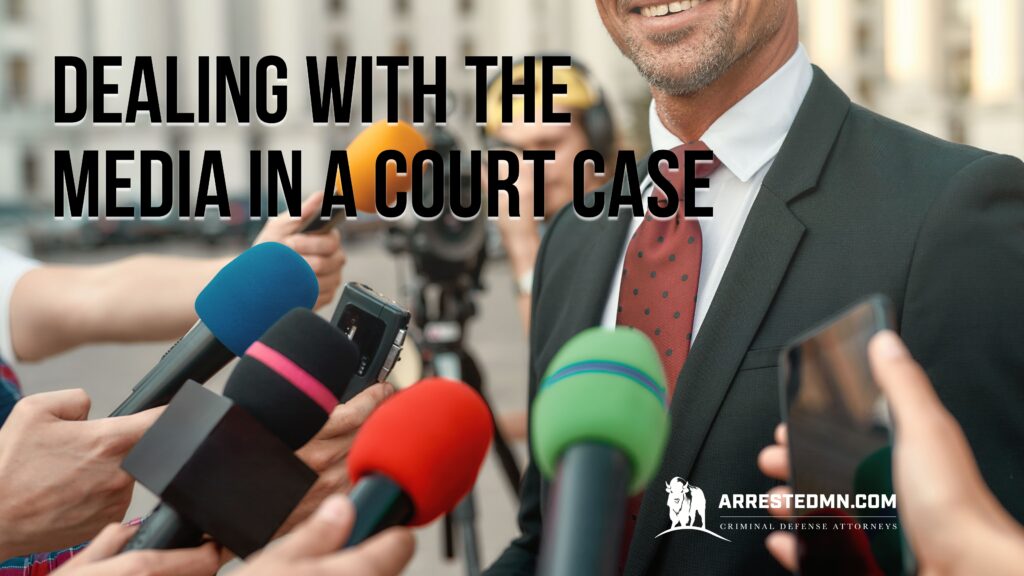
When criminal charges hit the news, your life changes in an instant – how to deal with the media in court cases.
It’s not just the case anymore. It’s your name, your job, your kids’ school, your neighbors, your reputation. One minute you’re walking into court trying to hold it together; the next minute there are cameras in your face, microphones shoved toward you, strangers shouting questions about the worst moment of your life.
If you or someone you love is facing criminal charges that could draw media attention, how you handle those moments in front of the cameras can shape how the public sees you—and sometimes how decision‑makers in the system see you—long before a jury ever hears a word of evidence.
This isn’t about “spin.” It’s about protection, preparation, and making sure one bad moment doesn’t become the only story anyone ever hears about you.
Below is a practical guide, based on how I (and other lawyers who routinely handle newsworthy cases) prepare clients when their case is in the media—even when they desperately wish it weren’t.
When Your Case Becomes News: What You’re Really Up Against
In a high‑profile case, you’re not just dealing with:
- The legal system (judges, prosecutors, defense, law, evidence)
- The emotional toll (fear, shame, shock, confusion)
You’re also dealing with:
- The court of public opinion – friends, family, employers, and strangers who may only see a 30‑second clip on the evening news.
- The narrative vacuum – if you and your lawyer don’t control what you can, the only story people hear is whatever comes from the charging documents and the prosecution’s podium.
Research has shown that pretrial publicity can influence how people think about a case—even jurors who are trying to be fair. Multiple studies have found that exposure to negative media coverage is associated with higher perceived guilt and harsher judgments, even when people are instructed to ignore it.¹
You cannot stop the media from reporting on your case. But you can:
- Avoid making things worse with your body language and reactions.
- Reduce the chaos and anxiety by planning ahead.
- Use experienced counsel to manage how (and whether) your side of the story is shared.
Step 1: Choose a Lawyer Who Actually Knows How to Deal With the Media
Most criminal defense is handled outside the spotlight. But when cameras show up, experience matters.
An attorney who regularly deals with local and national media will typically:
- Have existing relationships with reporters and producers
Reporters already have their cell number. They know this lawyer will answer, explain the process, and give them usable information or a clear “no comment” with context. - Recognize early when a case is likely to draw attention
Certain charges, certain fact patterns, certain locations—they light up the newsroom radar. A lawyer who’s been through this before often has “media radar” too and will prepare you before you’re walking into a wall of cameras. - Understand the rules of engagement
They know the difference between talking on background and talking on the record, how gag orders work, and when speaking publicly will help—or hurt—your case.
This doesn’t mean your lawyer is trying to turn your case into a show. It means they understand that when the media is involved, there’s now a second battlefield—and they know how to protect you on it.
Step 2: Expect the Cameras—and Prepare for Them
One of the worst things that can happen is to be surprised by the media when you’re already stressed walking into court.
Your lawyer should talk with you before the hearing about what to expect. If there’s a real possibility that news outlets will be there, you should assume:
- Cameras may be outside the courthouse doors.
- They may film you walking in and walking out.
- Some reporters may follow you for 20–100 feet, calling your name and asking questions you are not prepared to answer.
When you expect this, your brain doesn’t go into full panic mode. You don’t freeze. You don’t bolt. You follow a plan.
How to Present Yourself
You are not trying to “perform” for the cameras. You’re trying not to damage yourself.
Here’s what preparation looks like in reality:
- Dress decently and conservatively
You don’t have to look like you’re going to a gala. But you also don’t want to look like you just rolled out of bed. Clean, simple, respectful clothing helps communicate that you’re taking the process seriously. - Decide in advance how you’ll walk and where you’ll look
- Walk steadily, with your lawyer.
- Keep your face neutral and composed.
- You do not need to smile for cameras, and you do not need to scowl.
- You do not answer questions; your lawyer handles that.
- Avoid body language that screams “guilt”
Running from cameras, ducking your head, covering your face, shoving people aside—those visuals get replayed over and over again. To viewers who know nothing about your case, that looks like “I’m guilty, I’m hiding.”You might be terrified. You might be furious. But a few seconds of calm, deliberate walking can save you from a clip that makes everything worse.
Step 3: Let Your Lawyer Be Your Shield
A good defense lawyer doesn’t just stand next to you in court; they physically and strategically buffer you from the media when you’re in public spaces.
In practice, that can look like:
- Positioning themselves between you and the cameras
If cameras are on the left side of the entrance, your lawyer stands on that side with you on the opposite side, so the camera’s direct line of sight is to them—not your face. - Creating a “buffer bubble” of people
When appropriate, your lawyer may bring an additional attorney or staff member so that the group can form a loose “bubble” around you—still lawful, still respectful, but minimizing your exposure and stress. - Handling all communication
If reporters call your name, your attorney can respond briefly (“No comment at this time,” or “We’ll have a statement later”) so you don’t try to improvise under pressure.
You already have enough to worry about with your case. You should not also have to manage a scrum of reporters and cameras on your own.
Step 4: Understand “On Background” vs. “On the Record”
Where a media‑savvy lawyer really earns their keep is in deciding how to talk to the press—if at all.
There are two basic modes:
1. Talking “On Background”
When a lawyer speaks on background, it means:
- The conversation can be used for context, but
- The lawyer is not quoted by name or
- The specific statements are not directly attributed in print or on air.
Why this can help you:
- It allows your lawyer to quietly explain the legal process, upcoming court dates, and big‑picture defense themes.
- It gives the reporter enough context that they don’t need to chase you down the sidewalk for basic answers.
- It can nudge coverage away from wild speculation toward more balanced, accurate reporting—without turning your situation into a media fight.
Background conversations give reporters what they need to tell a responsible story while keeping you out of the line of fire.
2. Talking “On the Record”
“On the record” is different. That’s when:
- The lawyer can be named and quoted directly, and
- Statements may be used in TV clips, online articles, or print stories.
Speaking on the record is not always wise. Your lawyer needs to consider:
- Is there any gag order or ethical rule that limits what can be said?
- Will this help our client, or could it box us in later?
- Is the prosecution already holding a press conference or pushing a one‑sided narrative that needs responding to?
You’ve probably seen prosecutors hold press conferences with:
- A podium and official seal
- State flags behind them
- A row of officers or assistant prosecutors standing shoulder‑to‑shoulder
Those visuals are powerful. They send a message: We are in control. We have the power. We are right.
Sometimes, the only story the public hears initially is that story.
In the right case, a defense lawyer may decide it’s important to:
- Correct misinformation,
- Provide crucial context that’s missing, or
- Simply remind the public that charges are allegations—not proof, and that there is another side to the story.
That might mean issuing a brief statement, holding a defense press conference, or giving a limited interview.
But this is surgical, not emotional. It must be:
- Legally safe,
- Strategically sound, and
- 100% focused on protecting your long‑term interests, not winning a 24‑hour news cycle.
Step 5: Why Public Perception Matters (Even Though It Shouldn’t)
In a perfect world, only the evidence presented in court would matter.
In the real world:
- Employers see the news.
- Licensing boards see the news.
- Potential jurors may see or hear about the case.
- Family, friends, and communities form opinions long before trial.
Pretrial publicity can’t decide your guilt or innocence—that’s for the court. But it can:
- Affect whether you keep your job or professional license during the case.
- Shape the tone of how institutions and people treat you.
- Add enormous psychological pressure to you and your family.
That’s why preparation for the media piece isn’t “extra.” It’s part of real‑world damage control.
What You Can Do Right Now if a Case Is—or Might Be—in the News
If you or a loved one has a case that could attract media attention:
- Ask your lawyer directly about media strategy.
- “If the news shows up at court, what’s the plan?”
- “Will you speak to them on my behalf?”
- “How do we keep me from making things worse unintentionally?”
- If your lawyer doesn’t have much experience with media, share resources.
They may be an excellent trial lawyer who just hasn’t had to deal with cameras before. It’s okay to ask them to think this through with you in advance. - Do not talk to reporters on your own.
Not on camera, not off camera, not “just to tell your side.” One sentence said in panic can be replayed and dissected endlessly—and sometimes used against you. - Prepare yourself mentally for that walk into court.
- Decide now how you’ll carry yourself.
- Choose your clothes the night before.
- Make a plan with your lawyer about where to meet and how you’ll enter.
- Protect your emotional bandwidth.
Remind yourself: A camera lens is not a verdict. A news clip is not your whole life. Your job is to get through each step of the process with as much dignity and support as possible.
You Don’t Have to Face the Cameras Alone
If you’re reading this as the person charged—or as a spouse, parent, or friend of someone who is—there’s a good chance you’re scared, angry, and exhausted.
That’s normal.
But you don’t have to walk up those courthouse steps guessing what will happen, hoping you don’t accidentally make things worse.
With the right preparation and the right lawyer:
- You can walk into court knowing what to expect.
- You can let your attorney handle the shouting and the microphones.
- You can focus on the actual case—not the chaos outside the doors.
If you have questions about how to handle a criminal case that’s in the news—or you’re worried it might be headed there—you can reach me, attorney Ryan Pacyga, at:
- Website: arrestedmn.com
- Phone: 612‑339‑5844
You deserve a defense that protects not just your legal rights, but your dignity and your future—even when the cameras are rolling.
¹ For example, meta‑analyses of pretrial publicity research have found that exposure to negative news coverage is reliably associated with increased perceptions of guilt and harsher judgments among potential jurors compared to those who are not exposed (see, e.g., Steblay et al., Law and Human Behavior, 1999; Ruva & Guenther, Legal and Criminological Psychology, 2015).