
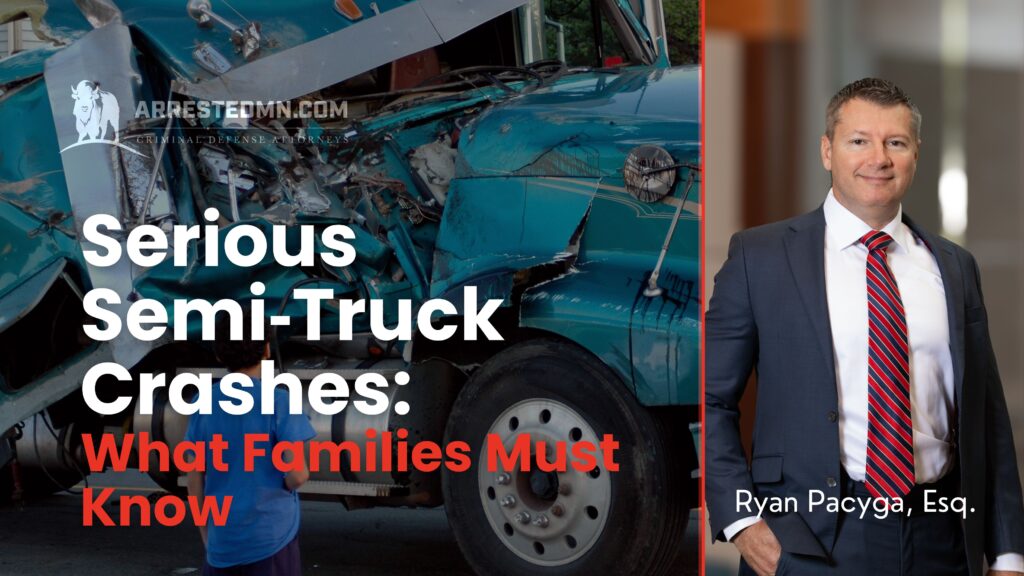
If you or someone you love is in a semi‑truck crash, you are not dealing with an ordinary car crash.
You are dealing with massive force, life‑changing injuries, and a system that starts protecting trucking and insurance companies almost immediately. While you are in pain, trying to keep your family afloat, there may already be people working behind the scenes to limit what you can recover.
What you do in the first days and weeks after a serious truck crash can change the rest of your case, your finances, and your future.
Below are the key things you need to know right away.
Why Semi‑Truck Crashes Are So Different From Car Crashes
Collisions with semi‑trucks are not just “big car accidents.” They are different in several important ways.
1. Injuries Are Often Much More Serious
A fully loaded semi‑truck can weigh 20 to 30 times more than a typical passenger car. That massive weight means:
- More violent impacts
- Greater risk of death or catastrophic injury
- Higher likelihood of long term disabilities
Common serious injuries from truck crashes include:
- Traumatic brain injuries and concussions
- Spinal cord injuries and paralysis
- Complex fractures and orthopedic injuries
- Internal organ damage
- Severe soft tissue and whiplash injuries
Because of the physics involved, people in smaller vehicles almost always come out worse.
2. Multiple Insurance Policies May Be Involved
With a typical car wreck, there may be only one or two applicable insurance policies. With a semi‑truck, there can be many more, including:
- The truck driver’s insurance
- The trucking company’s insurance
- The owner of the trailer’s insurance
- The company that hired the trucking company
- Maintenance company or manufacturer policies
This matters because more policies often mean more potential coverage. It also means more adjusters, more lawyers on the other side, and more opportunities for you to be shortchanged if the case is not handled correctly.
3. There Is Much More Evidence
Truck cases often involve evidence that does not exist in regular car crashes, such as:
- Electronic control module (ECM) data from the truck
- Driver logs and hours‑of‑service records
- GPS and telematics data
- Inspection and maintenance records
- In‑cab cameras (facing the road and the driver)
- Dash cameras or surveillance cameras along the roadway
All of this can help show what really happened, whether the driver was distracted, speeding, driving too long without rest, or violating federal and state trucking regulations.
However, this evidence does not last forever. Data can be overwritten. Video can be deleted. Paper records can be “lost.” That is why getting a lawyer involved early is critical.
Step One: Get Medical Attention, Even If You “Feel Okay”
Right after a crash, adrenaline surges through your body. It is your brain’s way of helping you survive a frightening event. Unfortunately, it also masks pain.
You might think:
- “I am just sore.”
- “It is just a headache.”
- “I am lucky. I walked away.”
Then, days or weeks later, serious symptoms appear.
This is especially true for:
- Soft tissue injuries that stiffen or worsen over time
- Brain injuries, which can start as a “simple” concussion and develop into a more serious traumatic brain injury
With a traumatic brain injury, symptoms like memory problems, mood changes, headaches, sleep issues, or difficulty concentrating can show up later, not just at the scene or in the ER.
That is why you should:
- Get checked out as soon as possible after the crash
- Go back to the doctor if new symptoms appear or old ones get worse
- Follow your doctors’ advice and keep follow‑up appointments
Your health comes first. Medical records also become vital evidence that your injuries are real and connected to the crash.
Do Not Give the Trucking Company’s Insurer a Recorded Statement
After a crash, you may get a call from an insurance adjuster who sounds friendly and concerned. They might say:
“We just want to understand what happened.”
“Can we record your statement? It is just routine.”
If they work for the trucking company, trailer owner, or another commercial policy, their job is not to help you. Their job is to:
- Save their insurance company as much money as possible
- Pay you as little as possible
They may try to:
- Get you to say something that can be twisted into an admission of fault
- Minimize your injuries by focusing on what “does not hurt”
- Lock you into a story before you understand the full impact of your injuries
A recorded statement can be used against you later. Do not give one to the trucking company’s insurance adjuster before you talk to a lawyer who represents you.
An attorney can:
- Advise whether you should give a statement at all
- Prepare you if a statement is necessary
- Be present with you to protect your rights
Do Not Sign Anything Without Understanding It
After a serious truck crash, you may be handed or mailed documents such as:
- Medical authorizations
- Releases
- Settlement agreements
- “Routine paperwork” from an insurance company
Do not assume any document is harmless just because someone tells you it is standard.
If you sign a release, you might be:
- Giving the insurance company access to years of unrelated medical history
- Waiving important rights you did not know you had
- Permanently closing your claim for far less than it is worth
Legal documents are full of dense language for a reason. A lawyer who understands truck cases can explain what a form really means in plain English and whether you should sign it, ask for changes, or refuse it altogether.
Once you sign, it is extremely hard or impossible to undo.
Preserve Critical Evidence As Soon As Possible
This is one of the biggest differences between serious truck crashes and ordinary car wrecks.
In truck cases, evidence can include:
- Electronic truck data about speed, braking, and engine performance
- Driver hours‑of‑service logs
- GPS and telematics data
- Maintenance and inspection records required by federal and state law
- Camera footage from inside and outside the truck
- Highway cameras, store surveillance video, and home security or doorbell cameras along the route
Much of this evidence is not kept forever in the normal course of business. Digital data can be overwritten. Video systems can record over old footage. Companies may only keep logs for a limited period unless they are told to preserve them.
An experienced truck accident lawyer can:
- Send a “preservation letter” that legally requires companies to keep relevant evidence
- Move quickly to obtain copies of important records and video
- Investigate the trucking company, driver, and other potentially responsible entities
If a company destroys evidence after being told to preserve it, that can harm them and help your case. But that only works if someone sends that preservation request in time.
Do Not Assume Only the Truck Driver Is Responsible
When a truck hits you, it is natural to focus on the driver. In many cases, the driver did do something wrong. But in serious truck crashes, the bigger question is:
Why did this crash happen, and who may be legally responsible?
Potentially responsible parties can include:
- The trucking company
- The company that hired the trucking company
- The owner of the truck or trailer (not always the same as the driver)
- A maintenance company that failed to do proper repairs
- A manufacturer that produced defective parts
- A shipper or loading company that packed the trailer unsafely
This is another reason truck cases are so different from car cases. There can be a whole chain of companies, contracts, and insurance policies that come into play. A thorough investigation looks beyond the driver to see who else may have contributed to the crash.
Stay Off Social Media
After a crash, it can be tempting to post about what happened, share photos, or update friends and family online.
Do not do it.
Anything you post may:
- Be saved, screenshotted, and taken out of context
- Be used as evidence against you
- Be twisted to suggest you are not as injured as you say
For example, a simple post like “I am just dealing with a headache today” can later be used to argue that your injuries were minor, especially if you later develop more serious symptoms.
It is safer to keep all details of the crash and your injuries off social media completely.
Document Everything
Good documentation can make a powerful difference in a serious truck case.
You and your family can help by:
- Keeping copies of all medical reports and bills
- Tracking days missed from work and lost income
- Saving receipts for expenses related to the crash
- Taking clear photos of visible injuries, both early and as they heal
- Photographing damage to vehicles and important items
It also helps to keep a simple journal about how the injuries affect daily life. For example:
- “I used to stand through my child’s entire game. Now I have to leave after 20 minutes.”
- “I cannot reach overhead to get pots and pans, so I cannot cook like I used to.”
- “Pain levels are worse at night and keep me from sleeping.”
Include improvements as well as struggles. The goal is an honest record. This gives a jury or insurance adjuster a window into your real life, not just your medical charts.
Do Not Rush to Settle Your Case
After a serious crash, you may feel intense pressure:
- Medical bills are piling up
- You are missing work and income
- Your family depends on you
- An adjuster is calling with a quick settlement offer
It is understandable to want the money as soon as possible. But settling too early can be a costly mistake.
Some injuries take months or longer to fully understand. Before you know what your case is worth, you need to know:
- What your future medical needs might be
- How your injuries may affect your ability to work or keep your job
- What long term limitations or pain you may have
Once you sign a settlement release, you usually cannot go back and ask for more money, even if your injuries turn out to be worse than anyone thought.
A good lawyer will help you balance the need for financial relief with the need to protect your long term future, not push you into a quick, low settlement just to close the file.
Choose a Lawyer Who Really Handles Serious Truck Crashes
Not every injury lawyer is equipped to handle complex truck cases. When you talk to potential attorneys, it is okay to ask tough questions, such as:
- Do you handle serious truck crashes regularly, not just car wrecks?
- Are you a member of organizations that focus on truck accident law, such as the Academy of Truck Accident Attorneys?
- Have you actually taken injury cases to trial? How many?
- Do you understand the federal and state regulations that apply to trucking companies and drivers?
- How do you investigate trucking companies and preserve electronic evidence?
- If the insurance company will not offer a fair settlement, are you prepared and willing to take my case to trial?
At Pacyga Trial Lawyers, we understand how to build a truck case from the ground up, prove it in front of a judge and jury, and go to trial if that is what it takes to get a fair result.
For Families: You Do Not Have to Carry This Alone
If your spouse, child, or another loved one has been hit by a semi‑truck, you may be juggling:
- Hospital visits and medical decisions
- Insurance calls and bills
- Work and childcare
- Your own fear and exhaustion
It is a lot. It is normal to feel overwhelmed.
Your first priorities can be simple:
- Make sure your loved one gets the medical care they need, and go back if symptoms change or worsen.
- Do not let them give recorded statements or sign releases without understanding them and getting legal advice.
- Help them connect with an experienced truck accident lawyer who can preserve evidence quickly.
- Help document what happened and how the injuries are affecting day to day life.
- Support them emotionally while a professional handles the legal and insurance battles.
You do not have to figure out federal regulations, data downloads, or complex insurance layers on your own. That is what a skilled truck accident lawyer is for.
If you or someone you love has been seriously injured in a truck crash in Minnesota, you deserve the truth about your options and a plan that protects your future, not just the next few weeks.
At Pacyga Trial Lawyers, we focus our practice on serious injury cases and complex truck crashes in Minnesota. Our team has tried many cases and achieved results strong enough that other lawyers have trusted us to represent them when they needed help themselves.
If you want to learn more about what to do after a serious truck or car crash, you can subscribe to our content or visit our website at mntriallaw.com.
You are dealing with enough already. You do not have to carry the legal fight by yourself. Reach out, get answers, and let a team that understands these cases stand between you and the trucking and insurance companies.
Your job is to heal and take care of your family. Our job is to fight for you.